





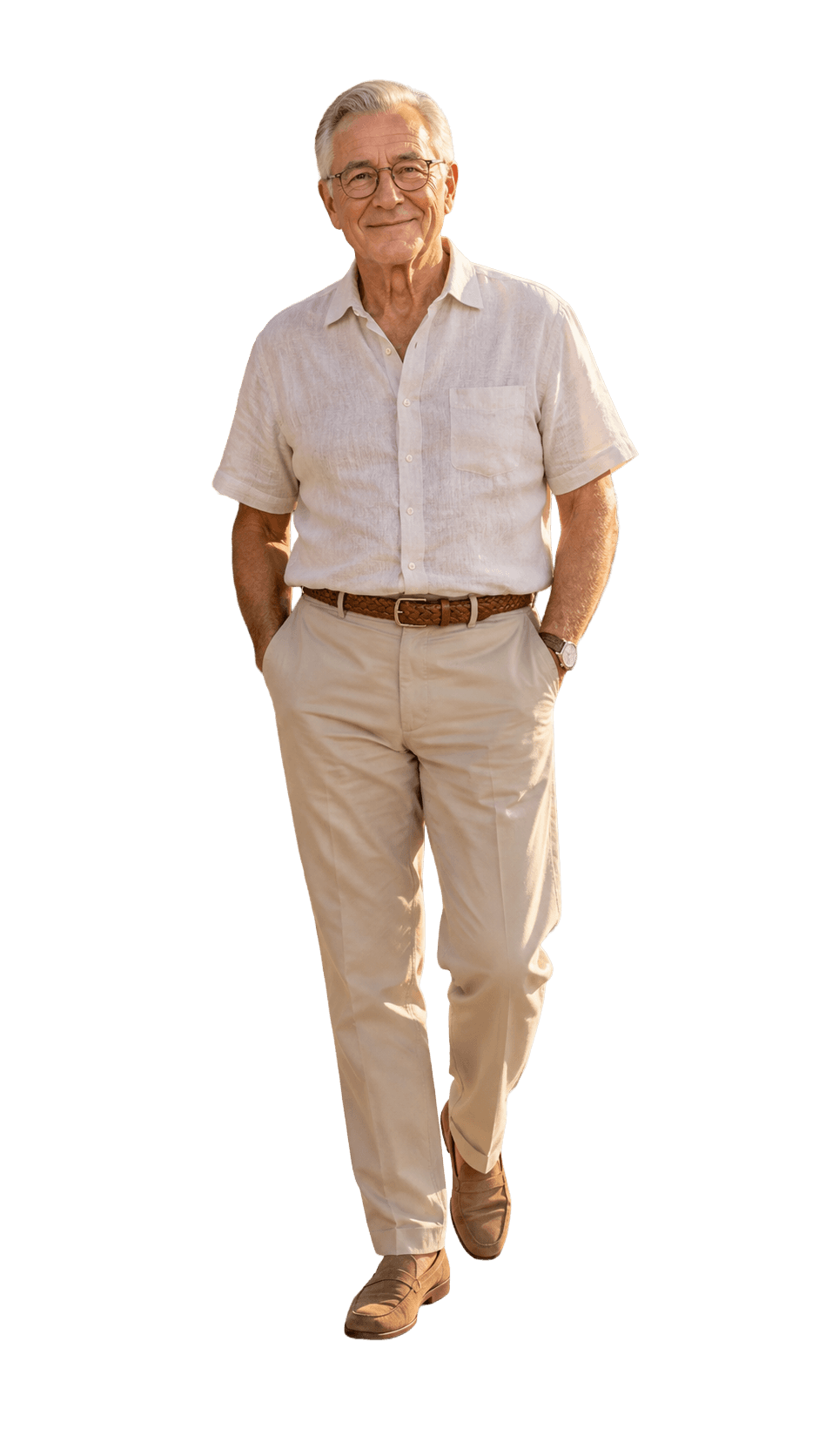

At seventy, Doug Rogers arrives at The Lavender Palms carrying six boxes of books, two drafting lamps, a collection of vintage pocket knives, and no real idea what to do with the life he has packed. Recently retired from a distinguished career as a landscape architect, Doug leaves Portland shortly after the death of his partner of more than forty years, the man with whom he had planned to share his retirement. What remains is an itinerary meant for two and a future built for one.
Portland’s rain, once familiar and comforting, has begun to make every street feel like a memory that refuses to come into focus. Doug chooses Palm Springs because it is the complete opposite of everything he knows. He wants hard sunlight, sharp mountains, dry air, and a horizon with nowhere for grief to hide. Instead, he finds himself lost in the courtyards of The Lavender Palms, emotionally unmoored and literally unable to locate the dining room. He speaks little, eats alone, and studies the landscaping because plants are easier than people. They need water, light, drainage, and the correct soil. These are problems Doug knows how to solve.
For decades, Doug designed urban parks, botanical estates, public courtyards, and elaborate private gardens for clients who wanted nature to appear spontaneous—but never unruly. His work gave him an exceptional understanding of topography, irrigation, drainage, soil chemistry, retaining walls, structural design, sight lines, and the subtle ways human activity changes a physical space. Doug does not merely look at a courtyard; he sees its slopes, access points, blind corners, disturbed surfaces, aging equipment, and everything that does not belong.
Julian Carter is among the first residents to notice the lonely newcomer. Alistair notices Julian noticing him and declares the situation intolerable. Ashley produces another chair, Dugger moves the sugar bowl, Julian hands Doug an iced tea, and no one gives him the opportunity to refuse. By the end of the meal, Doug has been added to dinner reservations, movie nights, and Julian’s list of people who need watching over. His new friends do not attempt to cure his grief. They do something far more meaningful: they make room for it and continue passing him things until he begins to feel part of the table.
Quiet, thoughtful, and deeply observant, Doug initially seems like the least likely member of the group to become involved in an amateur murder investigation. That impression does not survive long. While Alistair directs the operation, Dugger analyzes the evidence, and Ashley collects information from half the Coachella Valley, Doug becomes the group’s spatial analyst and resident “MacGayver.” Give him a bent paper clip, a pocket knife, a broken rubber band, and three minutes alone with a piece of machinery, and he will probably repair it, bypass it, or explain exactly why it was installed incorrectly.
When Julian’s death raises troubling questions, Doug reads the physical evidence everyone else walks past. He examines gates, pool equipment, irrigation systems, disturbed gravel, maintenance records, structural wear, and the angles from which events could, or could not, have occurred. His analytical mind makes him unusually disciplined. He distinguishes what the evidence proves from what it merely suggests and refuses to claim certainty where only possibility exists. The others may tell the story dramatically, legally, or through highly cultivated gossip; Doug determines whether that story could have happened in the real physical world.
His practical brilliance does not make him immune to the chaos surrounding him. His hearing aid has an unfortunate tendency to produce electronic shrieks during moments requiring silence, his careful plans regularly collide with Alistair’s theatrical direction, and the people around him repeatedly discover uses for his skills that no respectable landscape architect could have anticipated. Yet Doug meets every escalating disaster with the same quiet focus he once brought to collapsing retaining walls and impossible clients. He wastes no motion, offers little commentary, and usually has the problem solved before everyone else has finished arguing about it.
Doug’s determination to uncover the truth is rooted in more than evidence. Julian was one of the first people in Palm Springs to make him feel that his life had not ended with his partner’s death. Investigating what happened becomes Doug’s way of honoring the man who offered him friendship when he could barely imagine wanting it. Along the way, he begins the difficult work of returning to the world, not by leaving his grief behind, but by allowing new people to sit beside it.
Doug Rogers may begin the story as a man wandering through an unfamiliar garden, but he soon becomes indispensable to the people who pulled out a chair for him. He understands that damaged systems leave traces, that every space tells a story, and that even after devastating loss, something new can take root when others are willing to make room for it.
At seventy, Doug Rogers arrives at The Lavender Palms carrying six boxes of books, two drafting lamps, a collection of vintage pocket knives, and no real idea what to do with the life he has packed. Recently retired from a distinguished career as a landscape architect, Doug leaves Portland shortly after the death of his partner of more than forty years, the man with whom he had planned to share his retirement. What remains is an itinerary meant for two and a future built for one.
Portland’s rain, once familiar and comforting, has begun to make every street feel like a memory that refuses to come into focus. Doug chooses Palm Springs because it is the complete opposite of everything he knows. He wants hard sunlight, sharp mountains, dry air, and a horizon with nowhere for grief to hide. Instead, he finds himself lost in the courtyards of The Lavender Palms, emotionally unmoored and literally unable to locate the dining room. He speaks little, eats alone, and studies the landscaping because plants are easier than people. They need water, light, drainage, and the correct soil. These are problems Doug knows how to solve.
For decades, Doug designed urban parks, botanical estates, public courtyards, and elaborate private gardens for clients who wanted nature to appear spontaneous—but never unruly. His work gave him an exceptional understanding of topography, irrigation, drainage, soil chemistry, retaining walls, structural design, sight lines, and the subtle ways human activity changes a physical space. Doug does not merely look at a courtyard; he sees its slopes, access points, blind corners, disturbed surfaces, aging equipment, and everything that does not belong.
Julian Carter is among the first residents to notice the lonely newcomer. Alistair notices Julian noticing him and declares the situation intolerable. Ashley produces another chair, Dugger moves the sugar bowl, Julian hands Doug an iced tea, and no one gives him the opportunity to refuse. By the end of the meal, Doug has been added to dinner reservations, movie nights, and Julian’s list of people who need watching over. His new friends do not attempt to cure his grief. They do something far more meaningful: they make room for it and continue passing him things until he begins to feel part of the table.
Quiet, thoughtful, and deeply observant, Doug initially seems like the least likely member of the group to become involved in an amateur murder investigation. That impression does not survive long. While Alistair directs the operation, Dugger analyzes the evidence, and Ashley collects information from half the Coachella Valley, Doug becomes the group’s spatial analyst and resident “MacGayver.” Give him a bent paper clip, a pocket knife, a broken rubber band, and three minutes alone with a piece of machinery, and he will probably repair it, bypass it, or explain exactly why it was installed incorrectly.
When Julian’s death raises troubling questions, Doug reads the physical evidence everyone else walks past. He examines gates, pool equipment, irrigation systems, disturbed gravel, maintenance records, structural wear, and the angles from which events could, or could not, have occurred. His analytical mind makes him unusually disciplined. He distinguishes what the evidence proves from what it merely suggests and refuses to claim certainty where only possibility exists. The others may tell the story dramatically, legally, or through highly cultivated gossip; Doug determines whether that story could have happened in the real physical world.
His practical brilliance does not make him immune to the chaos surrounding him. His hearing aid has an unfortunate tendency to produce electronic shrieks during moments requiring silence, his careful plans regularly collide with Alistair’s theatrical direction, and the people around him repeatedly discover uses for his skills that no respectable landscape architect could have anticipated. Yet Doug meets every escalating disaster with the same quiet focus he once brought to collapsing retaining walls and impossible clients. He wastes no motion, offers little commentary, and usually has the problem solved before everyone else has finished arguing about it.
Doug’s determination to uncover the truth is rooted in more than evidence. Julian was one of the first people in Palm Springs to make him feel that his life had not ended with his partner’s death. Investigating what happened becomes Doug’s way of honoring the man who offered him friendship when he could barely imagine wanting it. Along the way, he begins the difficult work of returning to the world, not by leaving his grief behind, but by allowing new people to sit beside it.
Doug Rogers may begin the story as a man wandering through an unfamiliar garden, but he soon becomes indispensable to the people who pulled out a chair for him. He understands that damaged systems leave traces, that every space tells a story, and that even after devastating loss, something new can take root when others are willing to make room for it.